
Signs of Perimenopause
Signs Perimenopause Is Ending: What to Expect in the Final Stages
Recognize late-stage perimenopause symptoms, understand cycle changes, and prepare transitionally into menopause with clinical clarity and expert guidance.
- Longer Gaps Between Periods: Skipping 60+ consecutive days marks late perimenopause.
- Symptom Shifts: Hot flashes may intensify while breast tenderness and PMS lessen.
- The 12-Month Rule: Menopause is officially diagnosed after 12 full months without a period.
The signs perimenopause is ending can feel confusing because the final part of the menopause transition rarely follows a neat schedule. Your periods may become farther apart, hot flashes may change and sleep or mood symptoms may shift. Some symptoms can even disappear for weeks before returning. The final stage of perimenopause is the period leading toward your final menstrual period. During this late stage, hormone levels continue to change. Eventually, menstruation stops for good. However, you cannot usually predict the exact month when menopause will occur simply by looking at your symptoms.
Understanding Perimenopause and Its Final Stage
Perimenopause is the period surrounding the transition toward menopause. During the early stage, menstrual cycles may change subtly. You might notice shorter or longer cycles, heavier or lighter bleeding or an occasional missed period. As the transition progresses, periods often become more unpredictable and the gaps between them can become longer.
During late perimenopause, ovarian hormone production becomes increasingly irregular. Estrogen, also called oestrogen, does not simply fall in a smooth line. Instead, fluctuating estrogen, changing progesterone and other hormonal fluctuations can produce symptoms that appear, disappear or change intensity. The Menopause Society notes that late transition may involve skipped periods lasting 60 days or more.
How Do You Know You Are Nearing the End of Perimenopause?
One of the clearest signs perimenopause is coming to an end is a noticeable change in your menstrual pattern. Periods may become increasingly irregular with longer gaps between periods. You may experience skipped periods, sporadic bleeding or several months without a period. However, these changes alone cannot tell you exactly when your final period will occur.
Other perimenopause ending symptoms may include changing hot flashes, altered sleep, shifting mood symptoms and changes in migraine patterns. Some women notice that certain symptoms become less intense while others continue. This variation is normal because hormone fluctuations can continue until menopause is established.
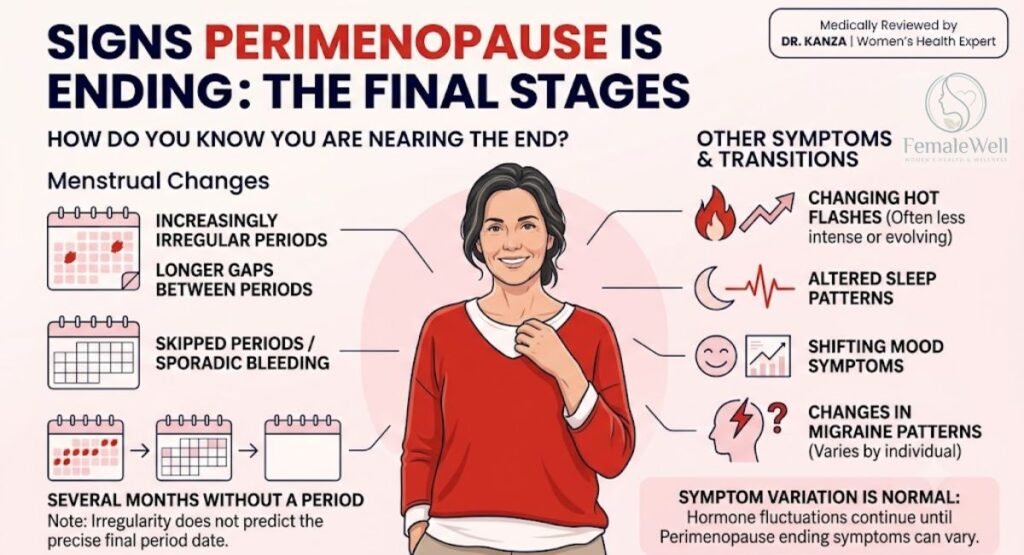
Key Signs Perimenopause Is Ending
As you enter the final stages of the transition, your body signals shifting hormone levels in distinct ways. Here is what to expect during late-stage perimenopause.
Your Periods Become More Irregular and Further Apart
One of the strongest signs perimenopause is ending is a growing distance between menstrual periods. You may have a period one month and then wait several months for the next. Bleeding may also become lighter, shorter, heavier or less predictable.
Hot Flushes and Night Sweats May Change
Hot flushes, known as hot flashes in the United States, are common vasomotor symptoms during the menopause transition. You may notice that they become less frequent or less intense as you approach or move beyond menopause.
Mood Changes May Become Less Severe
Mood swings, anxiety, irritability and low mood can occur during perimenopause. For some women, these symptoms become less severe as hormone fluctuations settle. For others, emotional symptoms may continue beyond the final period.
Migraines and Headaches May Change
Hormonal migraines can become more frequent during perimenopause because fluctuating estrogen directly impacts headache patterns. Some women find that migraine symptoms improve once menstruation stops, while others continue having headaches.
Sleep Patterns May Change
Sleep can become unpredictable during the final stages. Night sweats, anxiety, temperature spikes, and frequent awakenings disrupt rest. Later, sleep quality may improve as vasomotor symptoms diminish.
Vaginal Dryness & Urinary Changes Can Persist
Not every symptom fades when periods stop. Vaginal dryness, irritation, painful intercourse, and bladder symptoms (urgency, frequency, nighttime leaks, or recurrent UTIs) often become more noticeable as estrogen drops.
Weight and Metabolism May Change
Changes in body composition become more pronounced during the transition. Weight gain, particularly around the abdomen, occurs alongside shifts in metabolism, physical activity, sleep patterns, and body fat distribution.
Bone, Muscle, and Joint Changes May Accelerate
Declining ovarian estrogen accelerates changes in bone density and bone turnover. Many women also experience joint stiffness, joint discomfort, or changes in overall muscular strength during this period.
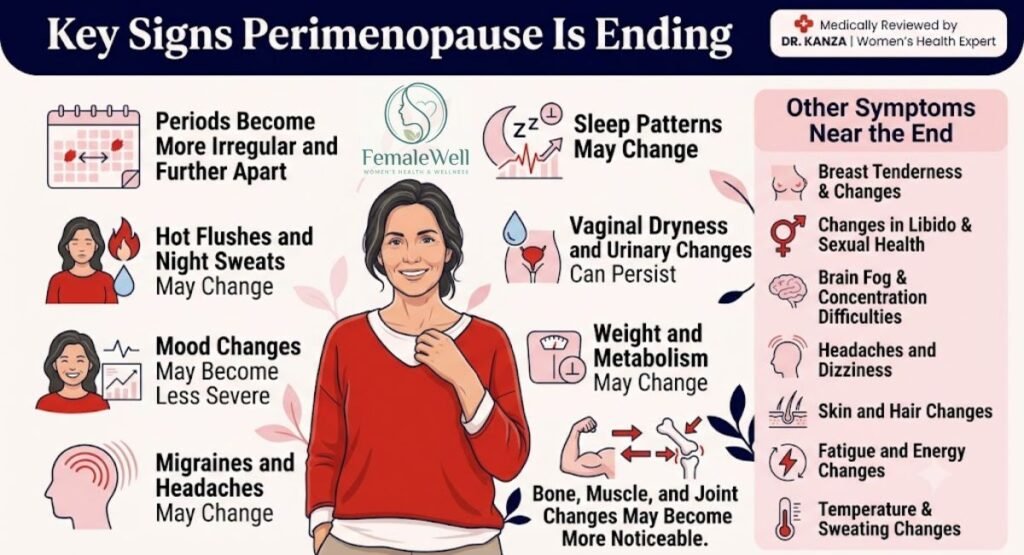
Other Symptoms You May Notice Near the End of Perimenopause
While period changes mark late perimenopause, shifting estrogen levels continue to affect various body systems. Here is what to monitor and when to consult your physician.
Breast tenderness can occur during periods of hormonal changes and fluctuating ovarian activity. Breast symptoms may change as cycles become irregular, although they are not among the most reliable signs perimenopause is ending.
Changes in libido can occur during perimenopause and after menopause. Lower estrogen may contribute to vaginal dryness, reduced lubrication, and painful intercourse, while sleep problems, mood changes, medications, and relationship factors can also influence desire.
Brain fog can feel like forgetfulness, difficulty concentrating, or struggling to find familiar words. Hormonal changes, poor sleep, stress, and mood symptoms may all contribute.
Headaches may change as ovarian hormone patterns shift. Women who experience hormonal migraines may notice increased symptoms during parts of perimenopause. Dizziness, however, has many potential causes.
Declining estrogen affects skin hydration and collagen synthesis. You may notice drier skin, changes in skin texture, or hair thinning. The NHS includes dry, itchy skin and hair thinning among recognized transition symptoms.
Fatigue can become frustrating during late perimenopause, especially when night sweats and mood symptoms disrupt sleep recovery.
Shifting temperature regulation causes daytime sweating, hot flushes, and night sweats. These vasomotor symptoms stem from alterations in the hypothalamus (the brain’s thermostat).
How Do You Know Perimenopause Has Actually Ended?
There is an important difference between recognizing signs perimenopause is ending and knowing that menopause has actually occurred. Symptoms can suggest that you are approaching the end, but they cannot usually confirm the exact date of your final period. For someone who is not using hormonal contraception, natural menopause is generally identified retrospectively. The key is the absence of menstrual bleeding for 12 consecutive months. In other words, you normally know that menopause has occurred only after the final menstrual period has already passed.
The 12-Month Rule for Menopause
The commonly used definition of menopause is 12 months without a period when there is no other explanation and hormonal contraception is not masking menstrual bleeding. This is sometimes described as 365 days without a period. The important point is that the date is counted from the final menstrual period, not from the first missed period.
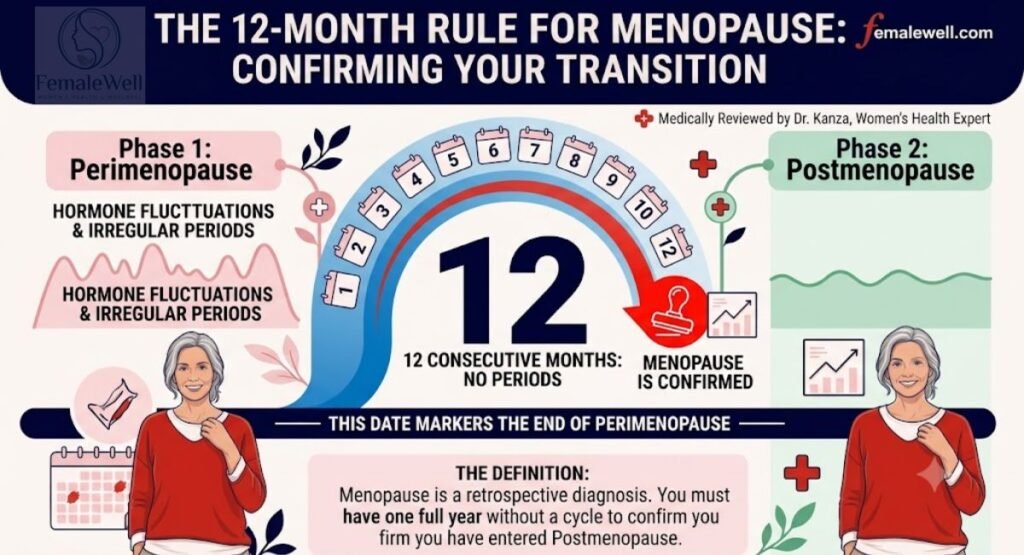
Once this milestone has been reached, you are considered to have entered postmenopause. The transition is therefore different from many medical conditions because the diagnosis often depends heavily on your menstrual history rather than one isolated blood test.
What If Your Period Returns After Several Months?
A period returning after months of absence is common in late perimenopause, but distinguishing expected cycle variability from postmenopausal bleeding is vital for your health.
A period returning after several months without bleeding can happen during late perimenopause. It simply means that menopause has not yet been confirmed because the required 12-month period without menstruation has not been completed.
You may move between long gaps and unexpected periods during this final transition. However, unusual bleeding should not automatically be dismissed as purely hormonal. If bleeding is unusually heavy, prolonged, or occurs between periods, discuss it with a clinician.
Bleeding During Perimenopause
During perimenopause, menstrual bleeding can become heavier, lighter, longer, shorter, or more irregular. Occasional spotting can also occur as hormone production fluctuates unpredictable.
Bleeding After Menopause
Bleeding after menopause is fundamentally different. Once you have gone 12 consecutive months without a period, any subsequent vaginal bleeding must be evaluated.
What Happens After Perimenopause Ends?
Reaching menopause marks a major biological milestone. Understand how your hormonal baseline stabilizes, what happens to estrogen levels, and which symptoms evolve or persist into postmenopause.
Hormonal & Symptom Trajectory Across Stages
Click on any phase to explore clinical shifts and hormonal levelsLate Perimenopause
Characterized by long gaps between periods (60+ consecutive days). Ovarian hormone production fluctuates wildly, producing peak vasomotor symptoms like hot flushes and intense night sweats.
Entering Menopause
Menopause is officially reached once you complete 12 consecutive months without a menstrual period. This single day marks the official boundary between perimenopause and postmenopause.
What Happens to Estrogen Levels & Symptoms?
Ovaries cease major estradiol production. While brain-related surges (hot flushes, night sweats, brain fog) gradually decrease in frequency over 2–5 years, lower hormonal levels create a new permanent baseline.
How Vaginal and Urinary Symptoms Can Change
Unlike hot flashes, Genitourinary Syndrome of Menopause (GSM) does not resolve over time without intervention. Lower estrogen leads to thinning, drying, and loss of tissue elasticity in vaginal and bladder linings.
12-Month Diagnostic Benchmark
Entering menopause is defined retrospectively after 12 full months without a period. Any bleeding after this mark warrants medical assessment.
Estrogen Level Plateau
Estrogen levels settle at a low, stable baseline rather than continually swinging up and down, which helps resolve hormone-driven mood swings.
Vaginal & Bladder Care
Vaginal dryness and urinary symptoms can persist or intensify post-menopause. Highly effective localized estrogen treatments and moisturizers are available.
Long-Term Health Considerations After Menopause
The end of reproductive years creates a key opportunity to focus on long-term wellness. Lower estrogen and aging influence bone, cardiovascular, metabolic, and genitourinary health, but proactive care makes all the difference.
Key Health Focus Areas
Select or tap any slice to inspect specific clinical considerations
Lower estrogen, aging, and lifestyle factors can influence several key physiological systems. These changes do not mean that illness is inevitable. Instead, this stage is an ideal time to review exercise, nutrition, blood pressure, cholesterol, glucose, smoking status, and personal risk factors.
Bone Health
Bone density can decline around menopause, making osteoporosis and osteopenia important considerations. The body experiences a period of rapid bone loss around menopause followed by slower ongoing loss.
Cardiovascular Health
Cardiovascular health deserves close attention because cardiovascular risk generally increases with age, and several key risk factors become more prominent post-menopause.
Metabolic Health
Changes in body composition and metabolism occur during midlife. Abdominal fat may become more prominent while muscle mass gradually declines with age.
Sexual and Genitourinary Health
Vaginal dryness, reduced lubrication, painful intercourse, and urinary symptoms can affect daily life, intimacy, and overall confidence throughout postmenopause.
Perimenopause vs. Menopause: What's the Difference?
The simplest distinction is that perimenopause describes the active transition toward the final menstrual period, while menopause is identified after 12 consecutive months without a period (when hormonal contraception is not obscuring the pattern). Postmenopause refers to all the years following menopause.
Why Your Experience Is Unique
The transition is not identical for everyone. Some women experience substantial menopause symptoms, while others notice little beyond period changes. This natural biological variation is why comparing your individual timeline directly with another woman can create unnecessary worry.
When to See a Doctor About Perimenopause Symptoms
Many symptoms during midlife are normal variations of hormonal change. However, menopause should not become a catch-all explanation for every new symptom. Medical evaluation is vital when bleeding changes or when symptoms are severe or sudden.
Clinical Urgency vs. Lifestyle Impact Index
Comparing Medical Priority (Red) against Quality of Life Disruption (Navy)
Heavy or Prolonged Menstrual Bleeding
Very heavy bleeding or prolonged flow deserves prompt medical attention rather than automatically being blamed on perimenopause. While hormonal fluctuations alter menstrual flow, fibroids, polyps, or other conditions can also cause abnormal bleeding.
Bleeding Between Periods & Bleeding After Sex
Bleeding between periods or after intercourse should be assessed when new or persistent. While friction or delicate tissue contributes to postmenopausal spotting, infections, cervical changes, uterine polyps, or medications must be ruled out.
Any Bleeding After Menopause
Any vaginal bleeding after established menopause requires formal evaluation. This includes light spotting, pink discharge, or brown discharge. While postmenopausal bleeding often stems from benign causes, it can sometimes be an early indicator of uterine cancer.
Severe Pelvic Pain or New Sudden Symptoms
Severe pelvic pain is not a defining sign that perimenopause is ending. New, intense pain can stem from gynecological, urinary, or gastrointestinal issues. Similarly, sudden neurological symptoms, severe headaches, or unexplained weight loss deserve proper diagnosis.
Symptoms That Interfere With Daily Life
You do not need to simply tolerate debilitating symptoms because they are related to midlife changes. Severe hot flashes, insomnia, anxiety, or vaginal discomfort can impact work, relationships, and wellbeing.
What Happens During Your Medical Evaluation?
A healthcare professional will review your menstrual history, medications, contraception, and personal risk factors. Depending on your situation, they may recommend physical examination, pelvic ultrasound, or blood tests. Routine hormone testing is not usually needed for typical menopause after age 45, but can be appropriate in selected circumstances.
Common Questions About the End of Perimenopause
The end of perimenopause can feel uncertain because symptoms rarely follow a predictable sequence. Below are clinical answers to common concerns regarding late-stage perimenopause, menstrual changes, and the postmenopause transition.
The strongest clues include increasingly irregular periods, longer gaps between periods, and eventually the complete absence of menstruation. Other signs perimenopause is ending may include changing hot flashes, sleep patterns, mood symptoms, or headaches. None of these symptoms alone confirms menopause—menopause is generally recognized retrospectively after 12 consecutive months without a period.
Yes. During late perimenopause, menstrual cycles often become increasingly unpredictable. Some women may go several weeks or months without bleeding before another period occurs. The Menopause Society notes that skipped intervals of 60 days or more can occur during the late transition, although the pattern varies considerably between individuals.
Yes. Symptoms can improve or disappear temporarily and later return. Hormone fluctuations are not perfectly predictable, so a symptom-free period does not necessarily mean that menopause has already occurred. Some symptoms also improve while others become more noticeable. This is why symptom duration alone cannot establish the end of perimenopause.
They can. Some women experience increasingly bothersome hot flashes during the menopause transition, while others have milder or intermittent symptoms. Eventually, many women experience improvement, but the timing varies. Night sweats and other vasomotor symptoms can also continue after menopause, so their presence does not necessarily mean that perimenopause is still underway.
Yes. Menstrual changes are common, but symptoms can appear before periods become dramatically irregular. You may experience hot flashes, mood changes, sleep problems, or headaches while still having relatively regular menstrual cycles. The menopause transition develops gradually, so symptoms and period changes do not always occur simultaneously.
There is no fixed duration for the final stage of perimenopause. Some women progress relatively quickly, while others experience irregular cycles and symptoms for years. Current NHS guidance notes that menopause and perimenopause symptoms can last several years and sometimes longer.
Yes. Pregnancy remains possible during perimenopause because ovulation can still occur even when periods become irregular. If you do not want pregnancy, continue using appropriate contraception until menopause has been confirmed according to medical guidance for your age and contraceptive method.
If you are not using hormonal contraception and there is no other clinical explanation, 12 consecutive months without a period marks menopause. You then officially enter postmenopause. The exact date of menopause is identified retrospectively because you cannot know a period was your final one until the required 12-month interval has passed.
Yes. Some postmenopausal symptoms can continue after the final menstrual period. Hot flashes, sleep problems, joint symptoms, vaginal dryness, and urinary symptoms may persist. Genitourinary symptoms can become more noticeable over time without treatment, so persistent vaginal or urinary problems deserve appropriate medical support.
No. Bleeding after menopause should always be checked by a healthcare professional, even when it happens only once or appears as light spotting. While postmenopausal bleeding is often caused by non-cancerous conditions, it can sometimes be a sign of cancer. Prompt medical assessment is essential.
No matching questions found. Try searching for terms like "bleeding", "hot flashes", or "pregnancy".
Key Takeaways: Recognizing the End of Perimenopause
The signs that perimenopause is ending usually appear as a gradual pattern rather than a single dramatic event. Understanding what to track and when to seek medical support can help you navigate this final stage with confidence.
Pattern of Cycle Changes
Periods become increasingly irregular, gaps grow longer, and menstruation eventually ceases. While hot flashes, mood shifts, migraines, and sleep disturbances may evolve, symptoms alone cannot confirm menopause without menstrual tracking.
The 12-Month Milestone
The definitive clinical milestone is 12 consecutive months without a period (when not obscured by hormonal contraception). Reaching this threshold marks the official entry into postmenopause.
Postmenopausal Symptoms
While vasomotor symptoms like hot flashes may improve over time, other changes—particularly genitourinary, vaginal, and urinary symptoms—can persist or become more noticeable without ongoing care.
Proactive Self-Care & Health
Track your symptoms, safeguard bone density, stay physically active, and do not simply "wait it out." Evidence-based symptom management and tailored treatments exist to protect your long-term quality of life.
When Professional Assessment Is Essential
Heavy bleeding, bleeding between periods, or any vaginal bleeding after postmenopause is established requires prompt evaluation by a clinician.
Next Steps for Your Transition