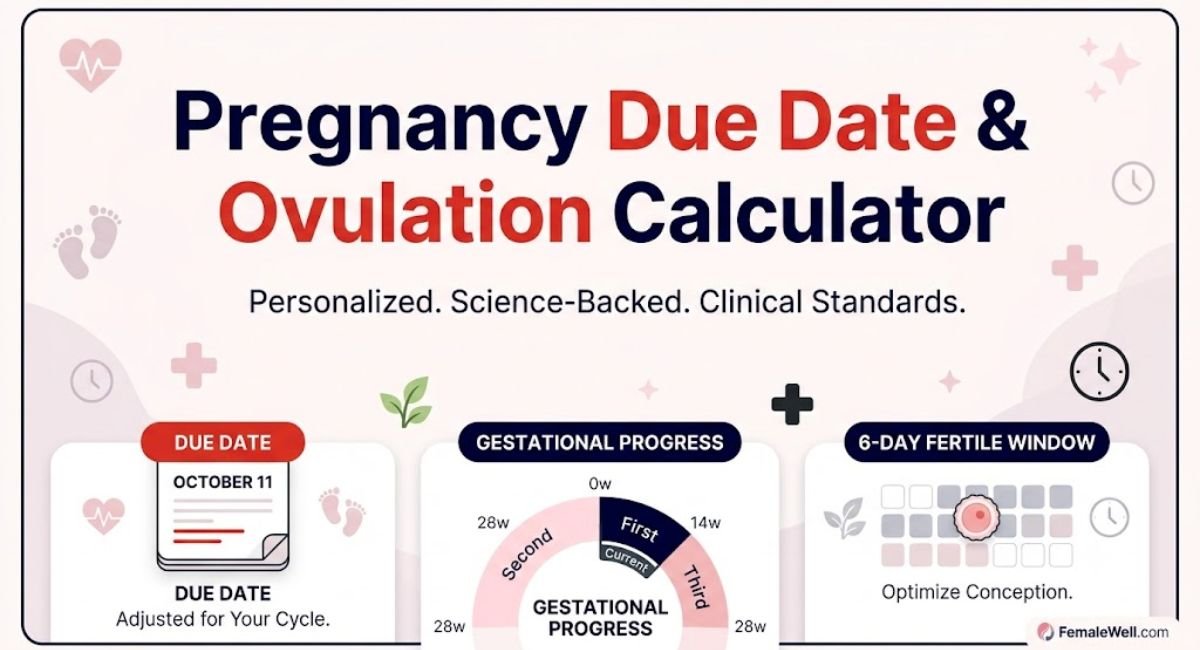

Pregnancy Due Date Calculator
Pregnancy Due Date & Gestational Age Calculator
Accurate gestational dating, trimester milestones, and clinical care routes tailored to your timeline.
Your Pregnancy Overview
Trimester & Fetal Milestones
Global Maternity Guidelines
🇬🇧 UK NHS Care Pathway
🇪🇺 EU Standard Protocol
🇺🇸 US Care Guidance (ACOG)
Upcoming Appointment Preparation
- Log any persistent symptoms, fatigue levels, morning sickness, or physical shifts.
- Write down your questions regarding prenatal supplements (Folate/DHA) and nutrition goals.
- Bring previous medical records, early blood work, or prior ultrasound reports.
- Check insurance authorization or local public health registration requirements.
How Pregnancy & Fertility Calculation Formulas Work
To estimate due dates, gestational age, and fertile windows, clinicians rely on standard biological milestones.
Core Biological Baselines
Gestational Age (GA)
Measured from the first day of the last menstrual period (LMP). A full-term pregnancy is estimated at 40 weeks (280 days).
Conceptional / Fetal Age
Measured from actual conception / ovulation. Fetal development spans 38 weeks (266 days).
The 14-Day Difference
Gestational age is typically 2 weeks (14 days) ahead of conceptional age because it includes the 14 days prior to ovulation when the follicle is maturing.
Pregnancy Due Date Calculation Methods
Healthcare providers use 5 core biological formulas to accurately calculate estimated due dates (EDD), conception dates, and gestational progress.
Last Menstrual Period (LMP) with Cycle Adjustment
Standard Naegele’s Rule (LMP + 280 days) assumes a strict 28-day cycle with ovulation occurring on Day 14. Because the follicular phase varies between women, we adjust for shorter or longer cycles to ensure precise dating.
Corrected LMP = LMP Date + (Average Cycle Length - 28)
Estimated Due Date (EDD) = Corrected LMP + 280 days
Estimated Conception Date = Corrected LMP + 14 days
Ultrasound Gestational Age (Back-Calculation)
First-trimester ultrasound (measuring Crown-Rump Length or CRL) is considered the gold standard in obstetric dating. It measures actual fetal length to reverse-calculate gestational age regardless of cycle irregularity.
Total Days at Scan = (Ultrasound Weeks × 7) + Ultrasound Days
Calculated LMP = Scan Date - Total Days at Scan
Estimated Due Date (EDD) = Calculated LMP + 280 days
In Vitro Fertilization (IVF) / ART
In IVF and assisted reproductive technology, the precise age and development stage of the embryo at transfer is known, eliminating cycle length guesswork completely.
Conception Date = Transfer Date - Embryo Age (3, 5, or 6 days)
Estimated Due Date (EDD) = Conception Date + 266 days
Calculated LMP = Conception Date - 14 days
Known Conception Date
Used when the exact day of ovulation or conception is confirmed through ovulation predictor kits (OPK), basal body temperature charting, or fertility tracking apps.
Estimated Due Date (EDD) = Conception Date + 266 days
Calculated LMP = Conception Date - 14 days
Back-Calculating from Established Due Date (EDD)
If a medical clinician has already assigned an established due date, you can reverse-calculate to find the underlying gestational age and conception timeline.
Calculated LMP = EDD - 280 days
Estimated Conception Date = EDD - 266 days
Gestational Age & Trimester Progress
Once the Calculated LMP is established, gestational progress is measured in exact weeks and days to track milestone developments across all three pregnancy trimesters.
Gestational Age Formula
How current pregnancy week and day are computed from target dates.
Total Days Elapsed = Target Date - Calculated LMP
Gestational Weeks = ⌊ Total Days Elapsed / 7 ⌋
Gestational Days = Total Days Elapsed mod 7
Example Output Format: A total elapsed duration of 75 days converts to 10 Weeks, 5 Days (10w 5d).
Trimester Milestones Breakdown
Standard obstetrical timeline categorized into three core stages.
Major organ development, initial heartbeat detection, and early ultrasound viability scans.
Rapid fetal growth, anatomical scan (18-22 weeks), and initial perception of fetal movements.
Lung maturation, rapid weight gain, final positioning, and labor preparation.

Ovulation & Fertile-Window Formulas
For pre-conception planning, formulas rely on the average luteal phase length—the standard 14-day interval between ovulation and the start of your next period.
Next Period Date
Projects the official start date of your upcoming menstrual cycle based on average cycle duration.
Next Period Date = First Day of Last Period + Cycle Length
Estimated Ovulation Date
Identifies the exact day an egg is released by subtracting the 14-day luteal phase from your next period date.
Ovulation Date = Next Period Date - 14 Days
6-Day Fertile Window
Calculates the peak 6-day fertile frame spanning the 5 days before ovulation through ovulation day itself.
Fertile Window Start = Ovulation Date - 5 Days
Fertile Window End = Ovulation Date
The Biological Science Behind the 6-Day Window
Why fertility calculations center on a specific 6-day timeline:
Sperm Lifespan
Sperm can survive in the fertile cervical fluid of the female reproductive tract for up to 5 days before ovulation.
Egg Viability
Once released during ovulation, an egg remains viable for fertilization for approximately 12 to 24 hours.
Peak Fertile Window
Intercourse during this 6-day timeframe gives sperm the highest probability of fertilizing the egg upon release.
Frequently Asked Questions
Everything you need to know about gestational dating, IVF due dates, international care pathways, and fertility tracking.
Standard pregnancy calculations assume a textbook 28-day cycle. If your cycles are irregular or longer, calculating strictly by your Last Menstrual Period (LMP) can result in an inaccurate due date. Our tool incorporates cycle-history personalization, allowing you to input your specific cycle length to adjust the outcome. However, if your cycles are highly unpredictable, an early ultrasound will provide the most reliable gestational dating.
In Vitro Fertilization (IVF) and ART dating are highly precise because the exact date of fertilization is known. By selecting the IVF method, the calculator uses your embryo transfer date and the specific age of the embryo (Day 3 cleavage, Day 5 blastocyst, or Day 6 blastocyst) to determine your exact gestational age, bypassing menstrual cycle guesswork entirely.
Maternity care schedules vary significantly depending on where you live. To support local care pathways, we outline standard appointment timelines—including booking appointments, dating scans, and anomaly scans—for the UK NHS, EU standard maternity routes, and US ACOG guidelines. This helps you anticipate doctor-discussion questions and prepare for the medical milestones specific to your region.
No. Fertility and ovulation calculators provide educational estimates to help you understand your reproductive window and optimize chances for conception. They cannot account for sudden biological shifts caused by stress, travel, or health changes, and must absolutely be avoided as a guarantee for contraception or pregnancy prevention.
Gestational age is measured from the first day of your last menstrual period (LMP) and is the standard metric used by healthcare providers to track your pregnancy (lasting about 40 weeks). Fetal age (or conceptional age) is the actual age of the developing baby, starting directly from the exact date of conception, which is typically two weeks shorter than your gestational age.