U.S. Fertility Rate Drops to Record Low in 2026
The record-low U.S. fertility rate: Why fewer Americans are having children
The record-low U.S. fertility rate reflects a major change in how Americans approach parenthood. More women are building careers before having children. Others are delaying pregnancy because of housing costs, childcare expenses or uncertainty about the future. Some decide not to become parents at all. Meanwhile, births among women in their 30s and early 40s continue to rise.
According to the Centers for Disease Control and Prevention (CDC), the United States recorded 3,612,012 births in 2025. The general fertility rate fell to 53.2 births per 1,000 women aged 15–44, a 1% decline from 2024. These figures reveal a changing reproductive landscape, but they do not explain every family’s decision. Understanding the reasons requires looking beyond statistics to health, finances and personal priorities.
Shifting Timeline
Explore related data on signs of perimenopause and ovulation calculator tools to understand biological planning windows.
Modern Care & Tech
Discover how innovations like Future of FemTech and AI Wearables, Blood Tests & Health Data assist modern family planning.

U.S. birth rate drops to record low, but older women are having more babies
The U.S. birth rate decline is not happening equally across every age group. Final 2025 figures from the CDC’s National Center for Health Statistics show that birth rates decreased among females aged 10–29 but increased among women aged 30–44. This shift highlights changing motherhood trends. More women are postponing pregnancy while pursuing education, financial independence or career stability.
However, a rising birth rate among older women does not mean pregnancy becomes easier with age. Fertility generally decreases as women grow older, although individual experiences vary. The record-low U.S. fertility rate therefore reflects several overlapping influences, including reproductive biology, changing preferences and economic conditions. These patterns also differ across communities and households. For deeper understanding, explore resources on signs of perimenopause and tracking windows using an ovulation calculator.
710,000 fewer babies were born last year in U.S. compared with two decades ago
The long-term decline in births deserves careful attention. The United States recorded approximately 3.61 million births in 2025, according to the CDC. Annual births were higher around the mid-2000s and peaked at approximately 4.3 million in 2007. The difference between that peak and 2025 is roughly 700,000 births. The exact comparison depends on the year selected, so the headline figure should not be interpreted as a direct comparison with 2005. See the CDC’s birth statistics for the latest finalized data.
For those exploring family planning or navigating fertility complexities, related insights on recurrent pregnancy loss genetic testing and empathy in fertility care provide crucial clinical context.
Steep drops in parenting among U.S. women in their 20s
The birth rates among women in their 20s have fallen as more young adults reconsider when or whether to become parents. In 2025, the birth rate for women aged 20–24 declined by 6%, while the rate for women aged 25–29 fell by 4%. Births also declined among women in their late teens, continuing a long-term reduction in teenage childbearing. The Federal Reserve Bank of Atlanta has examined how changing preferences and increasing medical difficulties may contribute to falling birth rates. Its research suggests that some Gen Z women are less likely to want children than earlier generations. However, preferences differ widely, and these findings do not explain every individual’s decision.
As reproductive technologies evolve to meet these shifts, platforms exploring the Future of FemTech and AI-Based Prediction of Preeclampsia offer valuable windows into modern obstetric care.
Interactive Live Data Visualizer: BIRTH RATES among WOMEN IN THEIR 20S in U.S. (2024–2026)
Dynamic live comparison showing live births per 1,000 women across AGE GROUPS based on FINAL CDC FIGURES and 2026 PROVISIONAL ESTIMATES.
The CDC’S FINALIZED FIGURES show that the rate fell by about 6% among WOMEN AGED 20–24 and 4% among WOMEN AGED 25–29 from 2024 to 2025.
What about 2026? The CDC’S LATEST RELEASE includes provisional quarterly estimates through Q2 2026 via its NATALITY DASHBOARD. The 12-month moving-average general fertility rate continues a slight downward trend into 2026 (moving from 53.7 to 52.7 in Q2 comparisons), helping avoid SEASONAL DISTORTIONS.
Population Shift
Fewer births can gradually change the shape of a country’s population. The declining child population in the United States is occurring alongside growth among older age groups. The U.S. Census Bureau estimated that the population under age 18 fell by approximately 1.8 million between April 2020 and July 2025. This change reflects more than fertility alone, since migration and population structure also influence demographic patterns.
Over time, population aging in America may affect schools, workplaces, healthcare services and retirement systems. Smaller school-age populations can challenge communities that rely on steady student enrollment. Meanwhile, an older population may increase demand for healthcare and long-term support. These effects unfold gradually, and a lower fertility rate does not automatically mean the total population will shrink immediately. For related tracking on life stages and health transitions, explore resources on signs of perimenopause and pelvic floor health.
3 generations of women in one family show how choices on motherhood have changed
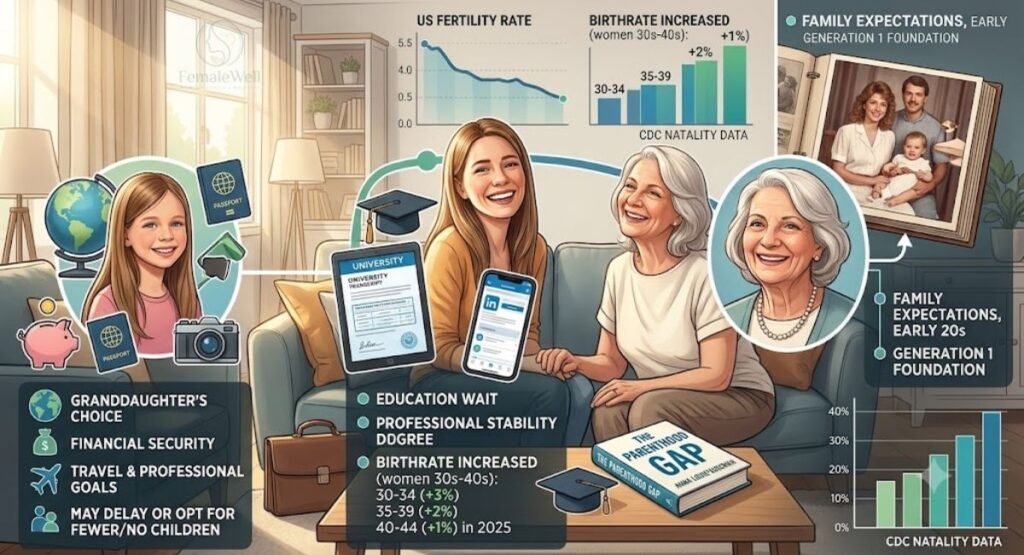
Three generations can reveal how generational differences in parenting shape modern family life. A grandmother may have started her family in her early twenties because that was expected in her community. Her daughter might have waited until she had completed her education. A granddaughter may prioritize financial security, travel or professional goals before considering children. Such examples illustrate possible changes in reproductive choices, but individual families cannot represent an entire country. Reliable reporting should use verified interviews and distinguish personal experiences from national fertility trends by age.
To better understand family planning windows and reproductive milestones, consult guides on the pregnancy due date calculator and the ovulation calculator.
Women in their 30s and 40s saw “significant” birthrate increase
The latest figures confirm that birth rates among women in their 30s and 40s moved upward in 2025. The rate rose by 3% among women aged 30–34 and by 2% among those aged 35–39. For women aged 40–44, it increased by 1%. These statistics support the trend toward delayed motherhood, although the increases do not mean all women are choosing later pregnancies. Career opportunities, relationships, financial preparation and access to reproductive healthcare can all influence the timing of parenthood.
Nevertheless, pregnancy at an older age may involve additional health considerations. Age can affect egg quantity and quality and increase the likelihood of certain pregnancy complications. Maternal mortality and other risks vary with individual health, medical history and access to quality care. Women considering pregnancy can discuss personal circumstances with a qualified healthcare professional. Egg freezing may preserve some reproductive options, but it does not guarantee a future pregnancy.
For comprehensive support through various reproductive stages, review specialized articles on recurrent pregnancy loss genetic testing, lab result explainer guide, and empathy in fertility care. Technical integrations and digital tools can also be examined via Future of FemTech and AI-Based Prediction of Preeclampsia.
Fewer children because of choice & affordability
The cost of raising children can turn a desired family size into a difficult financial calculation. Parents may consider rent or mortgage payments, food, education, transportation and time away from work. For some households, financial barriers to parenthood mean having one child instead of two or postponing pregnancy for several years. Others choose not to have children because their personal goals lie elsewhere. These are different experiences, and neither should be reduced to a single explanation for the declining fertility rates in America.
Research published by the Federal Reserve Bank of Atlanta in September 2026 also examined changing childbearing preferences and increased medical difficulties. Economic pressures matter, but they are not the whole story. Labor market opportunities, relationship circumstances, health and personal values can influence family planning decisions. The journalist and author Anna Louie Sussman has also explored the complexities of parenthood and reproductive choices. A balanced discussion recognizes both the desire to have children and the freedom to choose a different life.
For deeper insights into family planning milestones and clinical tracking, explore our guides on the pregnancy due date calculator, ovulation calculator, and signs of perimenopause.
Population Shift
A changing birth pattern can influence communities for decades. When fewer children enter the population, some regions may face declining school enrollment and a smaller future workforce. At the same time, longer life expectancy and the aging of existing generations can increase the share of older adults. The median age in the United States is shaped by these patterns alongside migration and mortality. These changes matter for planning, but they should not be treated as proof that every state or community will experience population decline.
To review broader wellness and preventive health perspectives, see resources on pelvic floor health and recurrent pregnancy loss genetic testing.
Families say cost of housing means they’ll have fewer or no children
For many prospective parents, housing affordability and family planning are closely connected. High rents, expensive home purchases and limited living space can make raising a child feel financially out of reach. Affordable housing is only one part of the equation. Daycare costs, health insurance, paid leave and reliable employment also affect whether families feel prepared to welcome a baby. When these expenses compete with basic needs, people may delay parenthood or decide to have fewer children.
Stronger support systems for families can help reduce some of these pressures. Affordable childcare, accessible healthcare, parental leave and flexible working arrangements may make it easier to combine career and motherhood. Policies differ across the United States, the United Kingdom and European countries, so comparisons should consider local costs and benefits rather than assume one system works everywhere. Ultimately, economic uncertainty can shape parenting choices, but practical support may help people make decisions that better reflect their preferences.
For comprehensive support through various reproductive stages, review specialized articles on lab result explainer guide, empathy in fertility care, and vaginal atrophy. Advanced digital health integrations can also be examined via Future of FemTech and AI-Based Prediction of Preeclampsia.
FAQs about The record-low U.S. fertility rate
Expert answers on fertility trends, demographic shifts, and family planning considerations in the United States.
The CDC’s final 2025 report recorded a general fertility rate of 53.2 births per 1,000 women aged 15–44. This measure differs from the total fertility rate, which estimates the number of children a woman would have over her lifetime if current age-specific rates continued.
For related clinical tracking tools, check our pregnancy due date calculator and ovulation calculator.
There is no single cause. Changing childbearing preferences, delayed partnerships, financial pressures, career plans and medical difficulties can all contribute. The relative importance of each factor varies between individuals and communities.
Explore broader insights on signs of perimenopause and recurrent pregnancy loss genetic testing.
Yes. The CDC reported increases in birth rates among women aged 30–44 in 2025. However, age-related fertility changes mean that delaying pregnancy can affect the likelihood of conception and certain pregnancy risks.
Review expert guides on lab result explainer guide and empathy in fertility care.
High housing expenses and childcare bills can make parenthood harder to afford. Access to affordable childcare, stable employment, health insurance and paid parental leave can influence whether families feel financially ready.
For comprehensive wellness and preventive health support, see pelvic floor health and vaginal atrophy.
Not necessarily. Population size also depends on immigration, deaths and the existing age structure. A lower fertility rate can contribute to slower long-term population growth and aging, but it does not determine the total population on its own.
Many European countries have experienced low fertility, but rates and family-support policies vary. The UK and EU should be assessed using their own national statistics and definitions rather than assuming that U.S. figures apply directly.
The record-low U.S. fertility rate is more than a demographic statistic. It reflects changing aspirations, health considerations and the practical realities of raising children. Understanding these influences can help communities and policymakers develop better support for people who want families while respecting those who choose a different path.
Explore cutting-edge digital health tools and trends via Future of FemTech and AI-Based Prediction of Preeclampsia.