Migraine & Endometriosis
The Relationship Between Migraine and Endometriosis: Causes, Endometriosis Symptoms, Migraine Symptoms, and Endometriosis Treatment
Living with recurring menstrual headaches, migraine attacks, and painful periods can be exhausting. For many women of reproductive age, migraine and endometriosis occur together as severe comorbidities, creating a substantial headache-related disability and overall burden on daily life.
Understanding the connection between endometriosis and migraine can help you recognize key endometriosis symptoms, identify a menstrually related migraine, and seek appropriate care from an endometriosis specialist or headache specialist.
Although clinical research highlights a strong association between migraine and endometriosis and an increased migraine risk in women with endometriosis, scientists have not established that one condition directly causes the other. Complex factors such as hormonal fluctuations, estrogen levels, systemic inflammation, immune dysfunction, and altered central pain processing contribute to their overlap and chronic pain conditions.
Knowing what recent clinical research on endometriosis and migraine shows empowers you to explore comprehensive care options—ranging from pelvic floor health to targeted pain management and CGRP therapy for migraine treatment—and discuss personalized treatment options for endometriosis pain with your healthcare provider.
COMPARISON BETWEEN MIGRAINE AND ENDOMETRIOSIS
Understanding how these two CHRONIC CONDITIONS intersect requires looking closely at their distinct yet overlapping mechanisms, symptoms, and impacts on daily life.
Migraine Disorder
Migraine is a complex NEUROLOGICAL DISORDER that causes recurring, severe HEADACHE-RELATED DISABILITY and other debilitating systemic symptoms.
- Throbbing head pain and intense MIGRAINE ATTACKS
- Nausea, vomiting, and cognitive fatigue
- Photophobia (light sensitivity) and phonophobia (sound sensitivity)
- Frequent presentation of MIGRAINE WITH AURA
Endometriosis Condition
Endometriosis occurs when ENDOMETRIAL-LIKE TISSUE OUTSIDE THE UTERUS contributes to systemic INFLAMMATION, scarring, and severe pelvic pain.
- Severe PAINFUL PERIODS (DYSMENORRHEA)
- Persistent PELVIC PAIN and ENDOMETRIOSIS-RELATED PELVIC PAIN
- Pain during intercourse (dyspareunia)
- Associated GASTROINTESTINAL DISCOMFORT and bladder irritation
Both CHRONIC PAIN CONDITIONS can heavily impact work performance, sleep cycles, personal relationships, and ANXIETY AND DEPRESSION. While some individuals experience both conditions concurrently due to shared GENETIC FACTORS and IMMUNE DYSFUNCTION, others develop only one. Recognizing these differences is vital for an accurate ENDOMETRIOSIS DIAGNOSIS and MIGRAINE DIAGNOSIS.

What Is Endometriosis?
ENDOMETRIOSIS develops when ENDOMETRIAL-LIKE TISSUE OUTSIDE THE UTERUS causes chronic INFLAMMATION and may form lesions on the ovaries, fallopian tubes, or other pelvic structures. Common ENDOMETRIOSIS SYMPTOMS include PAINFUL PERIODS, DYSMENORRHEA, PELVIC PAIN, PAIN DURING INTERCOURSE, GASTROINTESTINAL DISCOMFORT, and INFERTILITY. Some people also experience HEAVY MENSTRUAL BLEEDING or MENORRHAGIA, although these symptoms have other possible causes. EARLY MENARCHE and GENETIC FACTORS may influence risk, but no single cause explains every case. A timely ENDOMETRIOSIS DIAGNOSIS can help you explore suitable care, alongside supportive measures like pelvic floor health care.
Current ACOG guidance explains how clinicians assess symptoms and use imaging or other investigations when appropriate, backed by advanced healthcare technology.
Commonalities Between Endometriosis and Migraine
Both conditions can disrupt daily life and contribute to CHRONIC PAIN CONDITIONS. The ASSOCIATION BETWEEN MIGRAINE AND ENDOMETRIOSIS has received growing research attention. A recent systematic review covering 331,655 people found higher odds of MIGRAINE among those with ENDOMETRIOSIS. However, many included studies had a high risk of bias, so the findings do not prove causation. Other ENDOMETRIOSIS-ASSOCIATED COMORBIDITIES may include irritable bowel syndrome, interstitial cystitis, fibromyalgia, and chronic fatigue syndrome. ANXIETY AND DEPRESSION can also coexist with persistent pain. These overlapping challenges may contribute to HEADACHE-RELATED DISABILITY and reduced quality of life.
What Is the Connection Between Endometriosis and Migraine?
The precise CONNECTION BETWEEN ENDOMETRIOSIS AND MIGRAINE remains uncertain. Researchers are investigating HORMONAL FLUCTUATIONS, ESTROGEN LEVELS, INFLAMMATION, and IMMUNE DYSFUNCTION as possible shared mechanisms. HORMONAL CHANGES AND MIGRAINE are particularly relevant because ESTROGEN FLUCTUATIONS AND MIGRAINE can trigger attacks in susceptible individuals. Meanwhile, inflammation and altered pain processing may contribute to ENDOMETRIOSIS-RELATED PELVIC PAIN. GENETIC FACTORS IN ENDOMETRIOSIS AND MIGRAINE may also deserve further study. Although research suggests an INCREASED MIGRAINE RISK IN WOMEN WITH ENDOMETRIOSIS, scientists still need stronger evidence to establish which mechanisms matter most. Having both conditions does not mean one directly caused the other.

ENDOMETRIOSIS, MIGRAINE and MENSTRUATION
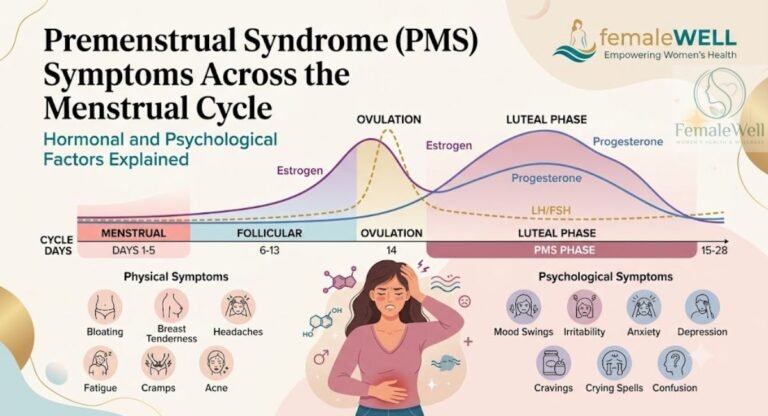
The MENSTRUAL CYCLE can influence symptoms of both conditions. A MENSTRUAL MIGRAINE occurs around menstruation, while a MENSTRUALLY RELATED MIGRAINE can occur during menstruation and at other times. A PURE MENSTRUAL MIGRAINE occurs exclusively within the menstrual window. ESTROGEN FLUCTUATIONS AND MIGRAINE may help explain why some people experience MIGRAINE ATTACKS DURING MENSTRUATION. At the same time, PAINFUL MENSTRUATION AND MIGRAINE can overlap, making everyday activities harder. Record headache days, PELVIC PAIN, bleeding patterns, and medication use for several cycles. This diary can help your clinician identify MENSTRUAL CYCLE-RELATED PAIN and distinguish recurring patterns from unrelated symptoms, while also monitoring your PMS symptoms across menstrual cycle variations.
What Are the TREATMENT OPTIONS FOR ENDOMETRIOSIS PAIN?
Effective ENDOMETRIOSIS TREATMENT depends on your symptoms, health history, and fertility plans. TREATMENT OPTIONS FOR ENDOMETRIOSIS PAIN include ANTI-INFLAMMATORY MEDICATIONS such as IBUPROFEN or NAPROXEN, when medically appropriate. HORMONAL THERAPY FOR ENDOMETRIOSIS may include ORAL CONTRACEPTIVES, PROGESTIN-ONLY CONTRACEPTION, or medicines such as ELAGOLIX, which reduces ovarian hormone production. A PROGESTIN-ONLY PILL may suit some people who need to avoid estrogen. In selected cases, LAPAROSCOPIC SURGERY can remove ENDOMETRIAL-LIKE TISSUE OUTSIDE THE UTERUS. However, ENDOMETRIOSIS RECURRENCE or persistent pain remains possible. A clinician should consider both conditions when planning treatment, especially when ORAL CONTRACEPTIVES AND MIGRAINE are part of the discussion.
What Type of Doctor Should I See for ENDOMETRIOSIS and MIGRAINE?
Coordinated care can make managing ENDOMETRIOSIS AND MIGRAINE together easier. A GYNECOLOGIST or experienced ENDOMETRIOSIS SPECIALIST can assess pelvic pain and discuss GYNECOLOGICAL CARE FOR ENDOMETRIOSIS. A NEUROLOGIST or HEADACHE SPECIALIST can help manage recurring headaches. A REPRODUCTIVE ENDOCRINOLOGIST may help when fertility concerns arise, while a GASTROENTEROLOGIST can investigate persistent digestive symptoms. A PAIN MANAGEMENT SPECIALIST or provider offering PELVIC FLOOR PHYSICAL THERAPY may also help with chronic pelvic pain. This kind of MULTIDISCIPLINARY CARE FOR CHRONIC PAIN can address different symptoms without assuming that one treatment will resolve everything.
A Note to Patients and Providers
Open communication helps clinicians recognize SYMPTOMS OF ENDOMETRIOSIS AND MIGRAINE that might otherwise be treated separately. If you experience both, record your headaches, possible aura, menstrual dates, pelvic pain, and medications before appointments. Providers should consider SCREENING FOR MIGRAINE IN ENDOMETRIOSIS PATIENTS and reviewing MIGRAINE WITH AURA AND HORMONAL CONTRACEPTION before prescribing estrogen-containing birth control. People with MIGRAINE WITH AURA generally should not use combined hormonal contraceptives containing estrogen because of stroke risk; a clinician can discuss safer alternatives. Good care relies on SHARED DECISION-MAKING IN HORMONAL TREATMENT, individual risk assessment, and realistic goals. Sudden severe headaches or new neurological symptoms need urgent medical assessment.
Allied Partner Resources – THE ENDOMETRIOSIS FOUNDATION OF AMERICA
Reliable resources can help you understand your options and prepare for appointments. The Endometriosis Foundation of America offers educational information on symptoms and care. The American College of Obstetricians and Gynecologists publishes clinical guidance, while the National Institute of Neurological Disorders and Stroke provides information about neurological conditions. You can also explore ClinicalTrials.gov to find clinical trials and ongoing CLINICAL RESEARCH ON ENDOMETRIOSIS AND MIGRAINE. Discuss any study with your healthcare provider before enrolling.
Prevalence of MIGRAINE in ENDOMETRIOSIS PATIENTS
Visual breakdown of observed MIGRAINE ATTACKS and CHRONIC PAIN CONDITIONS across clinical cohorts with an ENDOMETRIOSIS DIAGNOSIS. Explore our lab-result explainer guide or read about healthcare technology and AI analytics.
FAQs About the RELATIONSHIP BETWEEN MIGRAINE AND ENDOMETRIOSIS
Find clear answers regarding MIGRAINE AND ENDOMETRIOSIS, HORMONAL FLUCTUATIONS, and TREATMENT OPTIONS FOR ENDOMETRIOSIS PAIN. Utilize our lab-result explainer guide and explore AI-based symptom and condition tracking tools for personalized health insights.
Researchers have found an ASSOCIATION BETWEEN MIGRAINE AND ENDOMETRIOSIS, but direct causation remains unproven. Both CHRONIC PAIN CONDITIONS frequently overlap in WOMEN OF REPRODUCTIVE AGE experiencing severe PELVIC PAIN and MIGRAINE ATTACKS.
Changes in ESTROGEN LEVELS and ESTROGEN FLUCTUATIONS can trigger MENSTRUAL MIGRAINE and MENSTRUALLY RELATED MIGRAINE attacks in susceptible people during the MENSTRUAL CYCLE.
Effective ENDOMETRIOSIS TREATMENT may help some people by reducing systemic INFLAMMATION, but improvement is not guaranteed because each condition requires individual assessment by an ENDOMETRIOSIS SPECIALIST or HEADACHE SPECIALIST.
A PURE MENSTRUAL MIGRAINE occurs exclusively within the menstrual window, while a MENSTRUALLY RELATED MIGRAINE can occur during menstruation and at other times throughout the MENSTRUAL CYCLE.
Options depend on your symptoms, medical history, and contraceptive needs. Approaches may include ANTI-INFLAMMATORY MEDICATIONS, ORAL CONTRACEPTIVES, PROGESTIN-ONLY CONTRACEPTION, or HORMONAL THERAPY under MULTIDISCIPLINARY CARE FOR CHRONIC PAIN.
They should generally avoid combined hormonal contraceptives containing estrogen because of increased stroke risk. Reviewing MIGRAINE WITH AURA AND HORMONAL CONTRACEPTION with a clinician is essential for SHARED DECISION-MAKING IN HORMONAL TREATMENT.
A GYNECOLOGIST, NEUROLOGIST, or primary care clinician can help coordinate care. Seek prompt medical advice for worsening symptoms and urgent care for a sudden severe headache or new neurological changes.
Conclusion: The RELATIONSHIP BETWEEN MIGRAINE AND ENDOMETRIOSIS
The RELATIONSHIP BETWEEN MIGRAINE AND ENDOMETRIOSIS deserves careful attention because both CHRONIC PAIN CONDITIONS heavily impact pain levels, daily activities, and overall quality of life. Although current clinical evidence suggests they may coexist more often than expected among WOMEN OF REPRODUCTIVE AGE, researchers still need to clarify the underlying SHARED RISK FACTORS FOR MIGRAINE AND ENDOMETRIOSIS. Tracking symptoms, journaling MENSTRUAL CYCLE-RELATED PAIN, and seeking coordinated medical care can help you explore suitable TREATMENT OPTIONS FOR ENDOMETRIOSIS PAIN and pelvic floor health support.
Above all, you deserve to have recurring headaches, MIGRAINE ATTACKS, and PELVIC PAIN taken seriously rather than dismissed as an inevitable part of MENSTRUATION.
References & Clinical Literature
- Colombo GE et al. (2025). The association between endometriosis and migraine: A systematic review and meta-analysis of observational studies. The Journal of Headache and Pain.
- American College of Obstetricians and Gynecologists. (2026). Diagnosis of Endometriosis. ACOG Clinical Practice Guideline.